Write the starting batch in one place.
Keep the original ingredient quantities intact. Beside them, write the desired multiplier and the new amounts. This protects the source recipe from accidental edits and makes it easier to see which version you actually cooked. Include ingredients that appear in more than one step; “divided” is part of the instruction.
For a half batch, multiply each ingredient by 0.5. For one and a half batches, use 1.5. Keep the unit with every number. A scale can handle grams directly, but a volume-to-weight conversion needs the density of the specific ingredient, not a single universal cup weight.
Tare with capacity in mind.
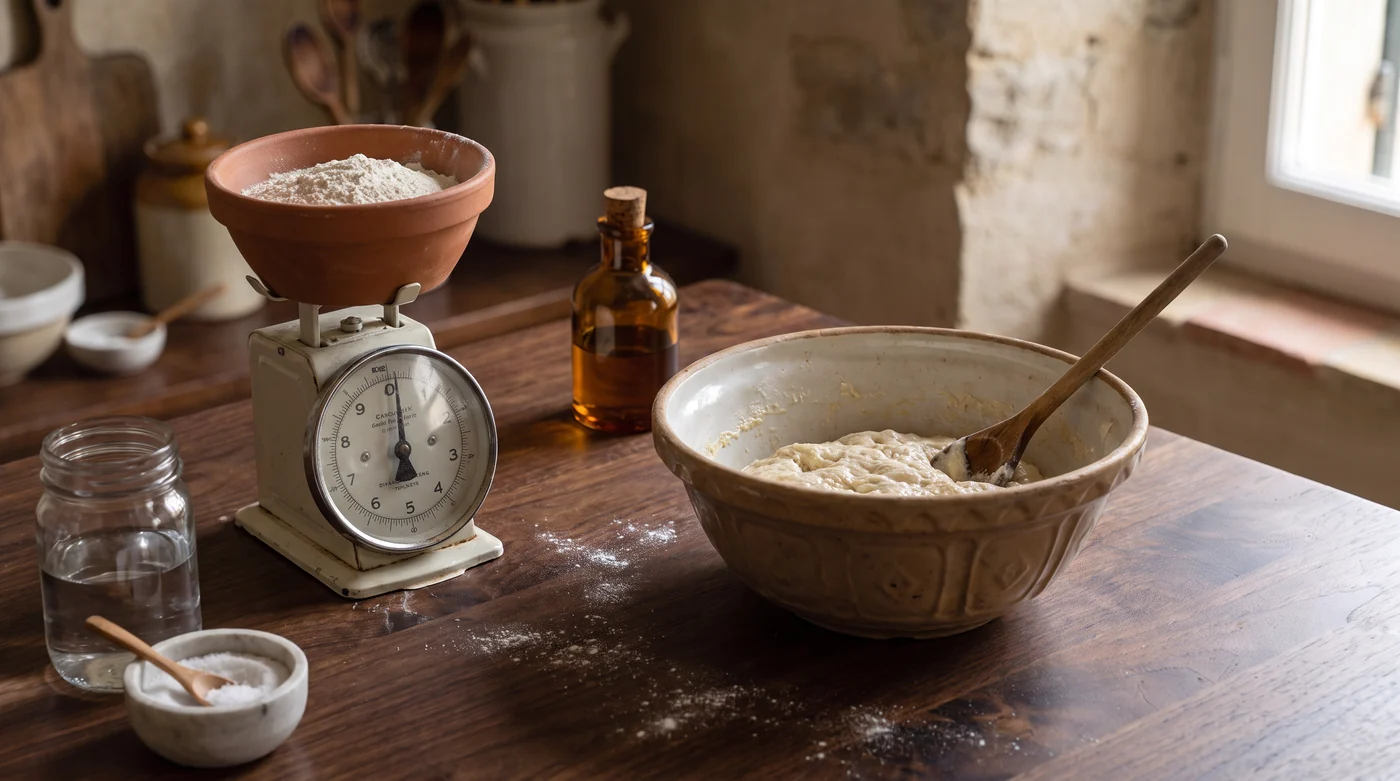
Set the empty vessel on the scale, use its zero or tare function as directed, and add the ingredient. The display may return to zero, but the physical load still includes the vessel. Keep the complete load within the scale’s specified capacity. Read the display and auto-off behaviour in the model’s instructions before a long sequence of additions.
The displayed increment also matters. A scale that advances in whole grams should not be treated as if it can resolve tenths. If the calculation produces a tiny amount of yeast, the precision of the arithmetic is not proof of precision in the measurement. Use an instrument suited to the dose.
Scale the ingredient, not the shell.
When a recipe change requires part of a whole egg, follow the recipe publisher’s guidance on weighing the edible egg. Our formula explorer accepts whole egg without the shell in grams. It does not infer egg size from a count, and it does not model separated whites and yolks as interchangeable.
Keep a note of rounding. Rounding 499.8 g flour to 500 g is different in proportion from rounding 0.4 g yeast to 1 g. The same absolute change can have a very different effect on a small ingredient. A purpose-built recipe for the smaller yield may be simpler than a batch that asks for unmeasurable amounts.
Give the larger batch enough room.
Review mixer limits, bowl size, pan dimensions and the number of cooking batches. A double batch may require two pans, not twice the height in one. Use the pan-area tool for a clearly defined comparison and keep the original recipe’s limits visible.
Do not double oven temperature or simply multiply baking time. Scaling changes the practical process, and the new result needs observation. Save the multiplier, equipment and changes together so that a successful version can be repeated.
Take this to the kitchen.
At the source
Original references consulted for this research edition. Manufacturer statements describe the named product; they are not our own test results.