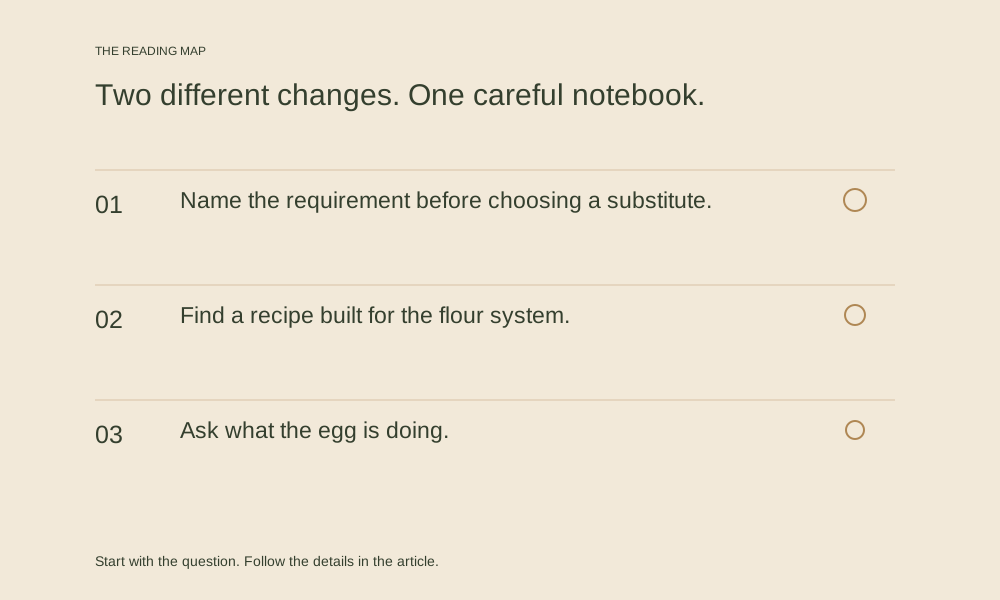

Name the requirement before choosing a substitute.
Gluten-free concerns gluten-containing ingredients and the suitability of the complete process. Vegan concerns animal-derived ingredients. One label does not imply the other. A gluten-free recipe can contain eggs and dairy; an egg-free loaf can still use wheat flour. Begin by writing the exact requirement and the kind of bake you want.
Do not turn a preference into a medical claim. Where someone has coeliac disease or an allergy, ingredient labels, cross-contact and individual requirements need appropriate care. Our recipe-development notes do not assess a person’s medical suitability.
Find a recipe built for the flour system.
“Gluten-free flour” is a category, not a single interchangeable ingredient. Different blends use different starches, proteins and binders. King Arthur Baking distinguishes between products intended for different baking jobs. That is a reason to retain the exact blend name in a development record, not to promise that a whole category can always be swapped one for one.
Write down the complete product name, ingredients and any separately added binder. Keep the source recipe and version. If the blend is unavailable in your market, finding a locally available recipe-and-blend combination may be more useful than translating a US product recommendation literally.
Ask what the egg is doing.
An egg can contribute structure, moisture, fat, emulsification or aeration, depending on the recipe and how it is used. A replacement should address that particular job. The same spoonful of purée is not a universal answer to a whipped-white foam and an enriched dough. King Arthur Baking’s egg-replacement guide explains this recipe dependence.
For a combined gluten-free and vegan bake, treat the complete version as a separate project. A successful egg replacement in one wheat recipe and a successful flour change in another do not establish that the two changes work together.
Keep useful evidence, including the failures.
Choose a clear goal: a focaccia that releases from the pan, a slice that stays together, or a pastry with distinct layers. Record the exact formula, method, pan and result after cooling. Change one main variable where possible, and retain the previous version rather than overwriting it.
The composition explorer can help you describe what changed by weight. It cannot confirm the texture or dietary suitability of the result. Until a recipe has been cooked and checked, label it as development work. A generated photograph can communicate the intended mood, but it cannot demonstrate a successful bake.
Take this to the kitchen.
Open the Baking Composition tool ↗
At the source
Original references consulted for this research edition. Manufacturer statements describe the named product; they are not our own test results.