
The journal
Does honing sharpen a knife? Check the rod and the edge
Traditional honing steels and abrasive rods do different jobs. Learn how to distinguish edge maintenance from sharpening and choose the knife maker’s method.

It depends on the tool. A traditional honing steel is used mainly for maintaining an existing edge, while an abrasive ceramic or diamond-coated rod can remove metal and sharpen. The word honing on a product label is not enough to identify what it does. Check the rod and the knife maker’s instructions.
Separate maintenance from removing metal
Shun’s product FAQ explicitly distinguishes its honing steel from its Fuji ceramic rod: the steel maintains edge alignment, while the ceramic rod removes material and is used more sparingly. That example explains why a blanket statement that every rod only realigns an edge is misleading.
Sharpening removes material to establish or renew the cutting edge. A maintenance steel may improve cutting when the existing edge has become misaligned, but it is not the same job as grinding out chips or rebuilding a worn bevel. If an appropriate light hone does not improve performance, reassess the edge rather than adding more force.
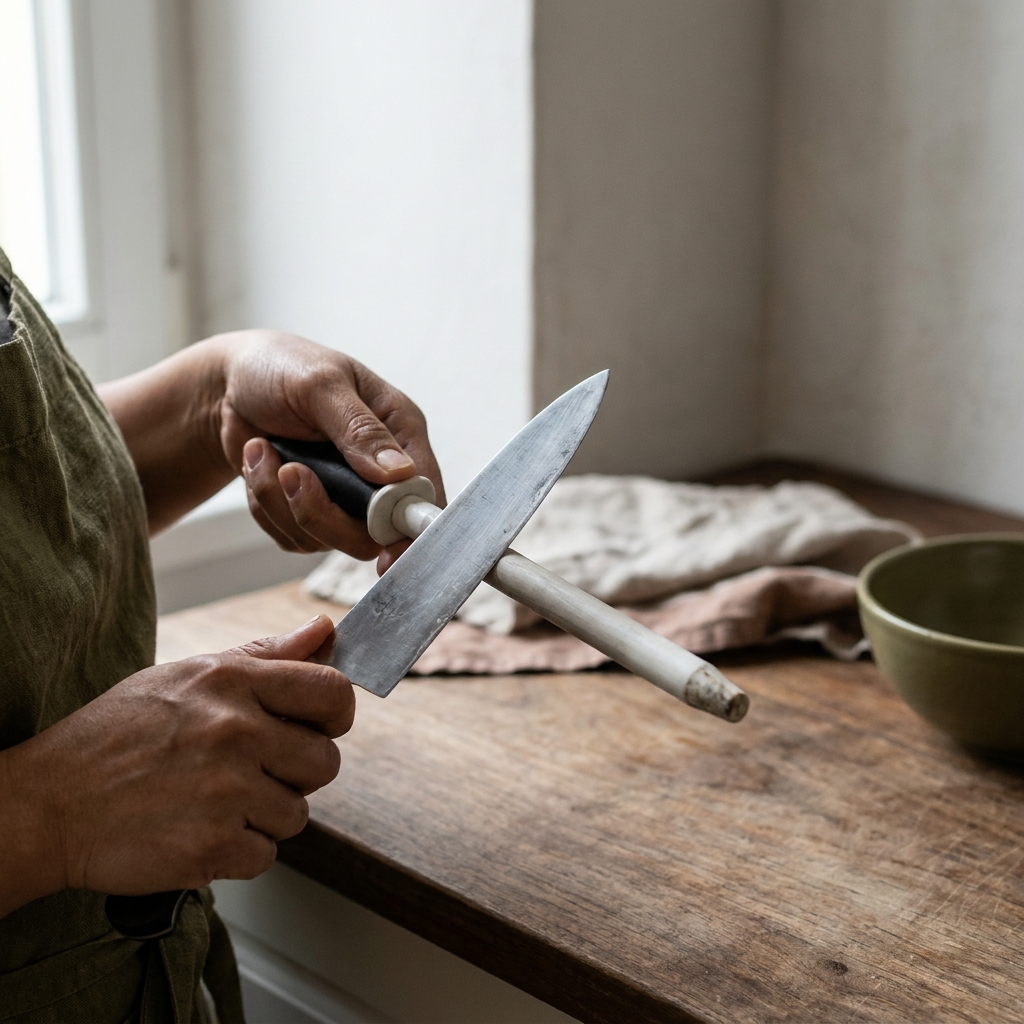
Match the knife, rod and angle
There is no universal 20-degree angle or compulsory number of passes for every kitchen knife. WUSTHOF’s supported-steel instructions give angles for its own knife types, while Shun describes a different angle guide for its products. Follow the specifications for the knife in your hand, not an average copied from another brand.
Check that the rod is appropriate for the blade material and edge type. A generic two-sided chef’s-knife method should not automatically be applied to a serrated, ceramic or single-bevel blade. If the maker does not approve that maintenance method, choose its recommended sharpening or service route.
Use a controlled supported method
For a compatible knife and rod, a point-down rod resting securely on a dry, non-slip surface is easier to control than fast airborne strokes. Keep the supporting hand behind the guard and the blade’s travel clear of fingers. Use light, deliberate heel-to-tip strokes at the required angle, alternating only as the maker’s method specifies.
Inspect the result after a few controlled strokes instead of chasing a fixed count. Clean the blade according to its care instructions before food preparation so maintenance debris is not carried into the food. If you are unsure of the technique, a suitable sharpening service is more useful than forceful repeated passes.
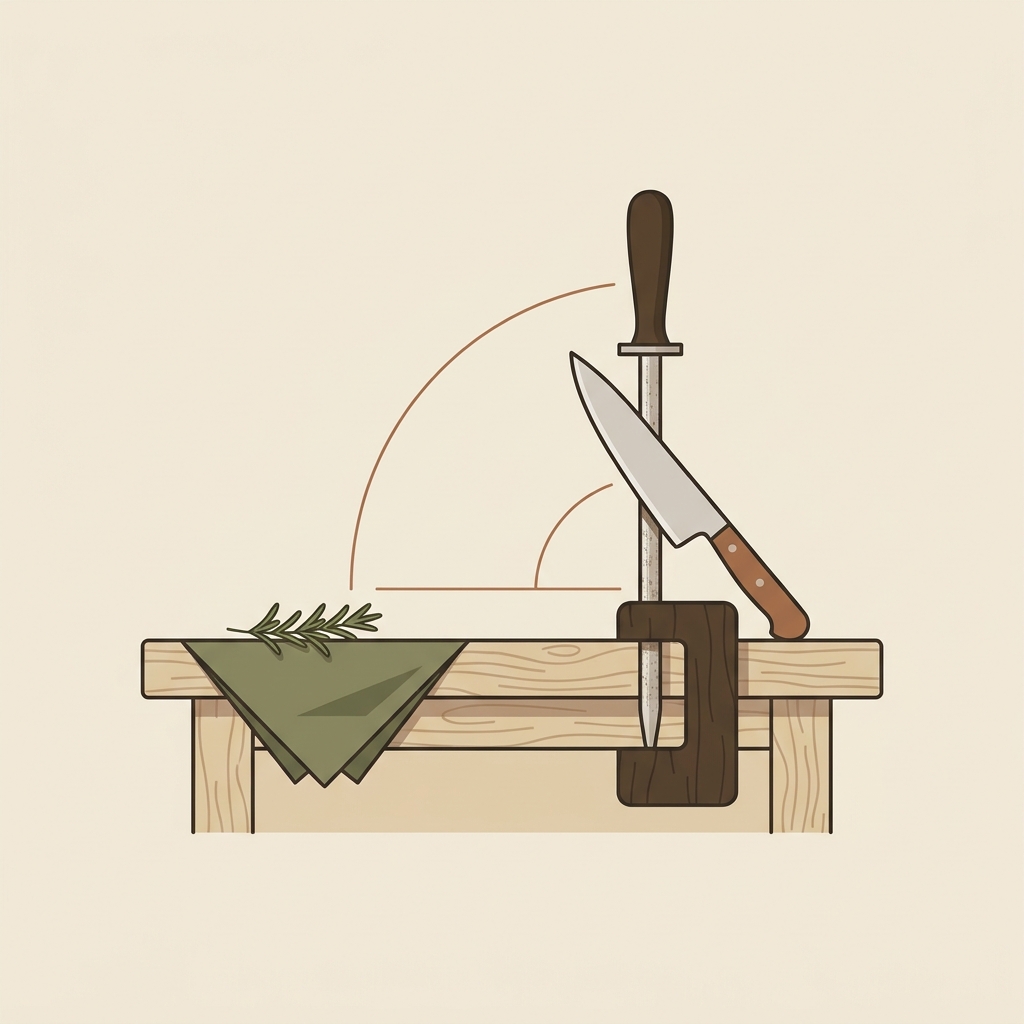
Decide what to do next
Ask whether the knife has simply lost some cutting performance or has visible damage. A blade that still drags after correct maintenance may need sharpening, but chips, cracks, corrosion and damaged tips deserve inspection and the right repair process. A smooth steel will not replace missing metal or make a cracked blade sound.
For the broader sequence, see our guide to sharpening and honing. Keep future wear down with an appropriate cutting surface and the knife’s cleaning and storage instructions; maintenance intervals depend on the blade, use and tool rather than a compulsory daily schedule.
Check the knife and rod before maintenance

Optional equipment for this guide
Use the maintenance tool your knife maker recommends. Some blades need a different honing or sharpening method, so do not choose a steel on length alone.
As an Amazon Associate I earn from qualifying purchases. These are researched options, not hands-on test results. Check the exact size or model, current price and availability on Amazon.
| Product option | Fit and limits to check | Retailer |
|---|---|---|
| Product imageVictorinox 7.8303 10-inch sharpening steel | A ten-inch steel for knives whose maker permits this type of honing. Check blade compatibility and technique; do not use on ceramic blades or expect it to repair chipped edges. | View on Amazon |