Start with the recipe you want to make
A focaccia pan should fit a particular dough and method. Before opening a product comparison, write down the recipe source, its specified pan and the amount you intend to bake. A pan that is excellent for a small, tall focaccia may be a poor match for a recipe spread across a large tray.
King Arthur Baking’s Big and Bubbly Focaccia, for example, yields one 9-inch square focaccia. Its pan instructions belong to that complete recipe. That is a useful reference point, not a universal size for every focaccia. If you already own the pan specified by the recipe, begin there; a specialist purchase needs to solve an identifiable problem.
Our shortlist questions are practical: does this vessel suit the recipe, fit the oven, have enough wall depth and suit the way you clean and store your tools? This guide is research and planning. We have not baked comparison batches in the products discussed here.
Read three different measurements
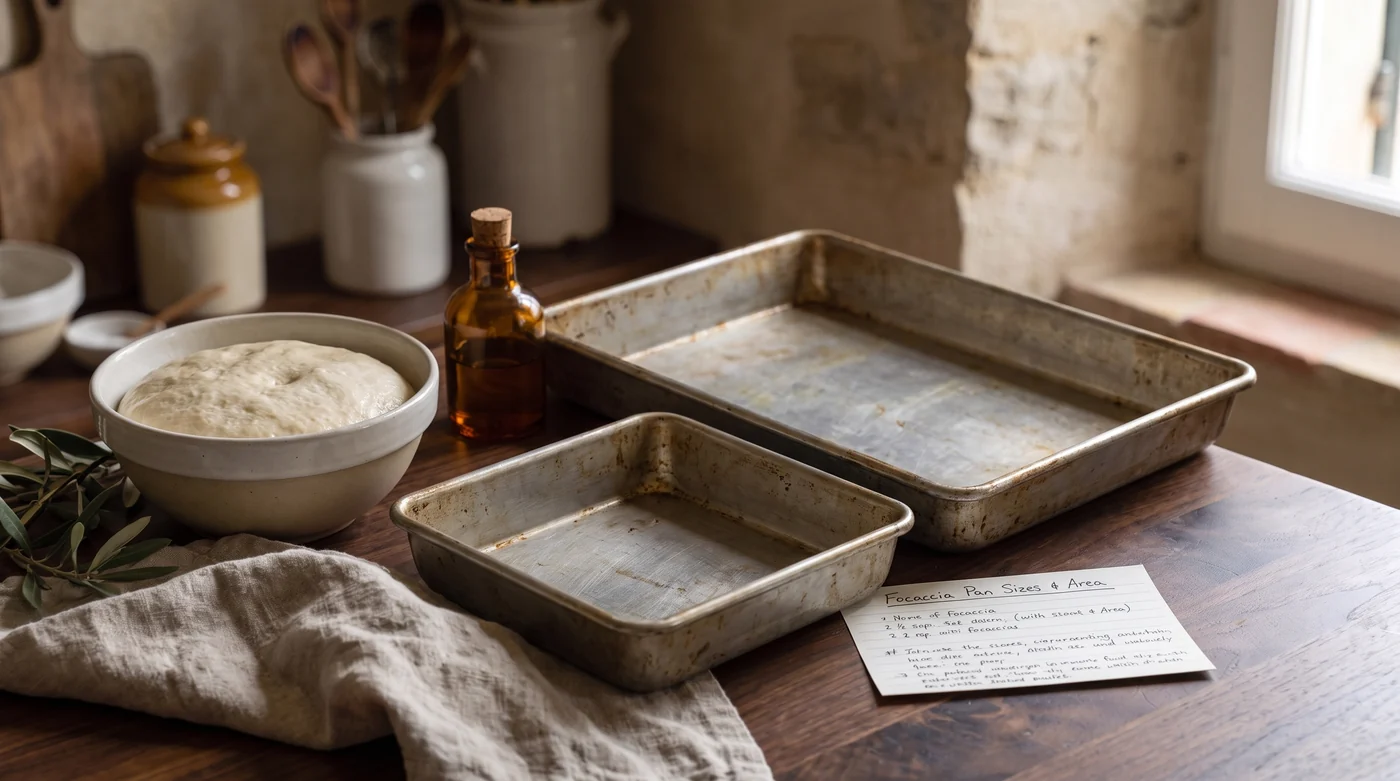
Keep the outside dimensions, inside base dimensions and wall depth in separate lines of your notes. The outside measurement helps you check oven and storage fit, including the rim and handles. The inside base is the starting point for our area calculator. Wall depth is a separate constraint; area alone cannot tell you whether dough has room to expand.
Product names can describe a nominal size. LloydPans’ Detroit-style range, for example, lists product sizes and a separate table of top dimensions, and describes angled sides. Do not treat a top measurement as a confirmed flat inside base. If the drawing does not identify the measurement you need, measure the pan you own or obtain the missing specification before calculating.
For a tapered pan, a single rectangular base calculation is only a simplified comparison. It does not calculate the increasing cross-section farther up the walls. Rounded corners and an uneven base introduce further differences. Keep that uncertainty visible instead of turning an approximate area into an exact capacity claim.
Use area to ask a better quantity question
Consider an illustrative change between two straight-sided rectangular pans with measured inside bases of 20 × 20 cm and 20 × 30 cm. Their base areas are 400 cm² and 600 cm². The second area is 1.5 times the first. For an otherwise comparable starting fill depth, 800 g of mixture would therefore become 1,200 g. These numbers describe geometry; they are not a focaccia recipe or a tested batch.
If you keep the original 800 g instead, the average starting depth would be about two-thirds as great, assuming the same mixture density and an even layer. That arithmetic explains why changing the pan while holding everything else constant is still a meaningful change. It does not predict the final bread’s height or texture.
King Arthur Baking’s recipe-reduction guide also uses pan area when adjusting quantities. A quantity multiplier is not a baking-time multiplier. Use the original recipe’s process and doneness guidance as your reference, and reconsider the bake when size or material changes. Our Pan Comparison tool shows the area calculation for your own measurements.
Compare the finish and the care instructions
A natural-aluminum sheet and a finished, deeper pizza pan are different candidates. Neither becomes the better focaccia pan just because a product page uses stronger praise. Record the stated material, coating or finish, oven-use limits and utensil guidance for the exact model. Read any recipe instructions about pan preparation alongside those specifications.
Nordic Ware lists the Naturals Baker’s Half Sheet as aluminum and recommends hand washing. Its care instructions advise against dishwasher use and recommend nylon, wood or silicone utensils; they also describe possible surface effects from prolonged contact with acidic ingredients. Those are useful ownership details to weigh before choosing that sheet.
LloydPans describes its Detroit-style pans as anodized aluminum with its PRE SEASONED TUFF-KOTE finish and says they do not require pre-seasoning. That statement describes the manufacturer’s finish. It does not mean every focaccia recipe can omit pan oil or preparation. We have not established a release, browning or durability winner between these products.
Make the purchase decision small and specific
Keep an existing pan if it matches a recipe you want to bake and its condition and care requirements suit you. Consider a different one when you can name the mismatch: an inside base too large for the intended quantity, insufficient wall depth, poor oven fit or a maintenance routine you will not follow. Check the exact model’s documentation before ordering; do not rely on a category name alone.
A useful first comparison would use a documented recipe, weighed ingredients and recorded pan measurements. Keep the oven mode, rack position and dough preparation consistent where possible. Record any necessary differences rather than hiding them. Photograph the pan, release and cooled crumb, and retain an unsuccessful bake as part of the record. Until that work is done, a spec-based shortlist is the appropriate description.
For now, take your two sets of inside measurements to the calculator below. Keep depth, material and oven fit beside the result. The aim is to buy a pan for a bake you actually want to make, with enough information to recognise when the match is wrong.
Take this to the kitchen.
Compare the whole pan with your measured oven space ↗
At the source
Original references consulted for this research edition. Manufacturer statements describe the named product; they are not our own test results.
- King Arthur Baking: Big and Bubbly Focaccia · Recipe-specific 9-inch square yield and complete method; not a universal pan recommendation. Consulted September 8, 2026. ↗
- King Arthur Baking: How to reduce a recipe · Using pan area as part of quantity adjustment. Our numerical example is independently calculated. Consulted September 8, 2026. ↗
- Nordic Ware: Naturals Baker’s Half Sheet · Manufacturer-stated aluminum material and use/care requirements, not our performance evidence. Consulted September 8, 2026. ↗
- LloydPans: Detroit-style pizza pans · Manufacturer-stated finish, angled sides and separately labelled product/top dimensions, not our baking test. Consulted September 8, 2026. ↗